Jiangnan University & SCUT | AEM 2026 | Novel Green Manufacturing Process: Using Hyaluronic Acid for Toxicity Isolation to Achieve High-Titer Fer
Jiangnan University & SCUT | AEM 2026 | Green Manufacturing Innovation: Hyaluronic Acid Enables Toxicity Sequestration for High-Titer Mcofp-3 Fermentation
You may have encountered mussel foot proteins (Mfps) in the ingredient lists of repair masks and medical dressings. Featuring robust wet adhesion and tissue repair activity, they act as a “biological band-aid” for skin with impaired barriers. Nevertheless, conventional recombinant expression in Escherichia coli suffers from a critical bottleneck:
Owing to the highly cationic and hydrophobic properties of Mcofp-3, its soluble fragments severely disrupt host metabolism, resulting in arrested cell growth and even bacterial death, which greatly restricts protein yields.
Recently, joint research from South China University of Technology and Jiangnan University published in Applied and Environmental Microbiology (AEM, 2026) proposes an ingenious solution:
Hyaluronic acid (HA) drives condensate‑based sequestration. During protein synthesis, free disruptive fragments are encapsulated inside condensate droplets formed via intracellular liquid–liquid phase separation. This strategy avoids disturbance to host metabolism, successfully overcoming bottlenecks restricting large-scale production of mussel foot proteins. Meanwhile, functional modification of target protein is achieved, and the obtained protein exhibits excellent skin repair efficacy.
------
Question: Why does Mcofp-3 trigger self-killing of E. coli?
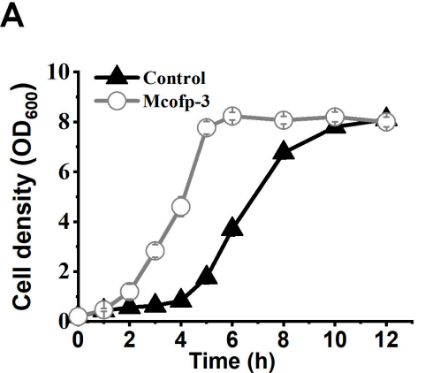
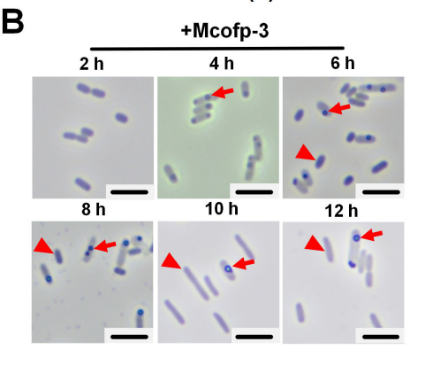
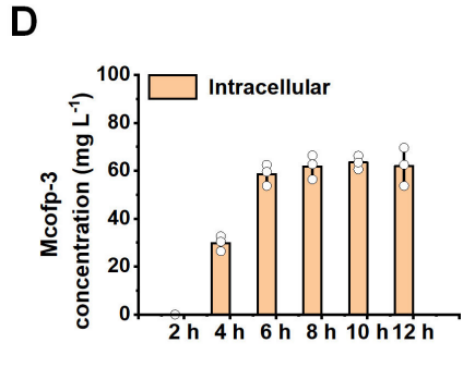
n When ordinary E. coli expresses Mcofp-3 containing abundant cationic residues, the soluble protein fragments interfere with intracellular metabolism. Upon IPTG induction, bacterial growth halts immediately, and highly refractive inclusion body particles emerge inside cells. Eventually, protein synthesis ceases completely. As a result, shake-flask titers are capped at approximately 60 mg/L, severely limiting target protein expression.
n Conventional optimization strategies (reducing IPTG concentration, lowering cultivation temperature, delaying induction time) only lift the maximum titer to 250 mg/L, which merely addresses the symptoms rather than the root cause.
------
Condensate‑Based Sequestration Strategy: Sequestering Toxic Protein via HA
�� Core Mechanism
Mcofp-3 is abundant in cationic Lys/Arg residues on its surface. High-molecular-weight hyaluronic acid (HA), a polyanion, binds to Mcofp-3 via multivalent electrostatic interactions. This process triggers intracellular liquid–liquid phase separation (LLPS) within the crowded cytoplasm and drives the formation of dense hydrophilic condensates.
>>> Mcofp-3 is recruited into HA condensate droplets through electrostatic attraction. The concentration of disruptive free fragments in the cytoplasm drops sharply, alleviating the metabolic burden on host cells.
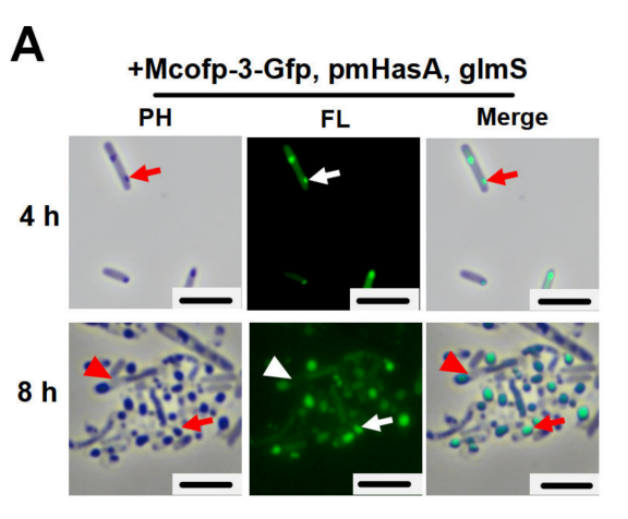
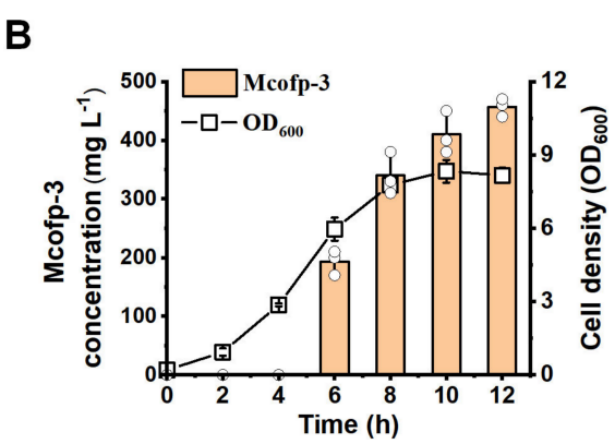
Upon co-expression of Mcofp-3-GFP, fluorescence concentrates in particles instead of dispersing in the cytoplasm, and bacterial growth returns to normal.
�� Key Design
The hyaluronic acid synthase gene pmHAS from Pasteurella multocida was introduced into E. coli. Overexpression of UDP-sugar precursor synthetic genes (especially ugd) enables intracellular biosynthesis of high-molecular-weight HA of approximately 410 kDa. Subsequently, HA undergoes spontaneous LLPS to form condensates. Co-expressed Mcofp-3 is then sequestered and protected within these condensates.
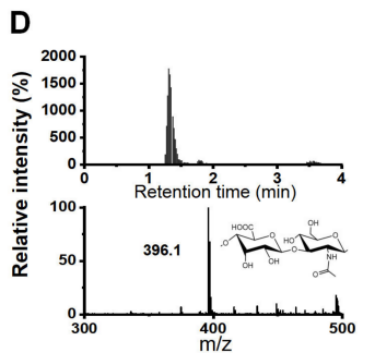
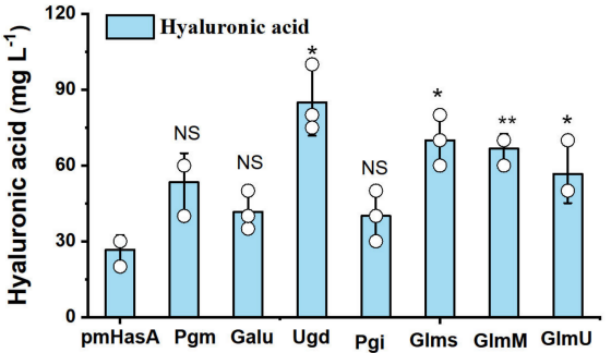
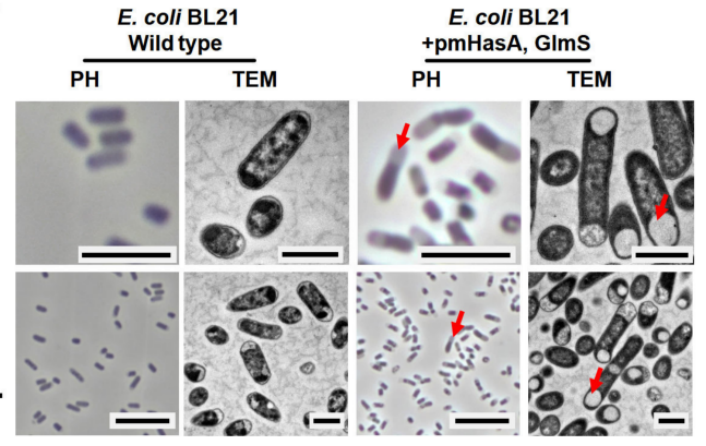
⚠️Notably, excessive HA can trigger cell lysis, so a balanced synthesis level must be achieved. This issue can be efficiently resolved by employing EC06 (pmHasA + GlmS) as the chassis strain.
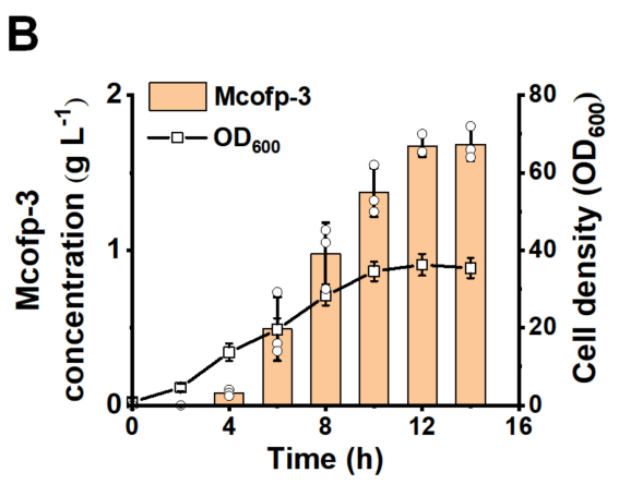
Titer increased by around 27-fold versus conventionally optimized E. coli.
------
DOPA Modification Enhances Skin Repair Capacity
Anti-Inflammatory Effect
It inhibits excessive NO release in LPS-stimulated RAW264.7 macrophages and downregulates IL‑8 mRNA expression.
Anti-Stress Effect
It upregulates Hsp70/Hsp90 to alleviate heat-induced damage.
Pro-Repair Activity
It accelerates scratch wound closure in HaCaT keratinocytes and fibroblasts.
üApplication Scenarios
Post-medical-repair dressings for cosmetic and medical procedures
Barrier-repair serums and creams for sensitive skin
Bionic bioadhesive auxiliary materials
Breakthrough in Mass Production | Efficient DOPA Modification | Superior Skin Repair Performance
1.Intracellular condensates constructed by hyaluronic acid efficiently sequester Mcofp-3 via electrostatic interaction, significantly alleviating the cytotoxicity of target proteins toward E. coli. This strategy achieves a 27-fold leap in protein production titer. 2.The self-developed immobilized tyrosinase system enables efficient DOPA modification of Mcofp-3. The modified Mcofp-3 exhibits prominent anti-inflammatory and pro-migration capacities, possessing broad application prospects in medical dressings and skin repair biomaterials. 3.This study establishes a universal and green synthetic platform to relieve cytotoxic protein expression inhibition, unlocking critical pathways for the industrialization of bionic mussel adhesive proteins and other functional proteins.
------
For the full manuscript, please contact us:
Hu L, Chen L, Wang Y, et al. Condensate‑based sequestration enables high‑efficiency synthesis of mussel foot protein Mcofp-3. Appl Environ Microbiol. 2026. doi:10.1128/aem.00786‑26